Playing the Lottery
 Gallahad ・ Aug 12, 2026
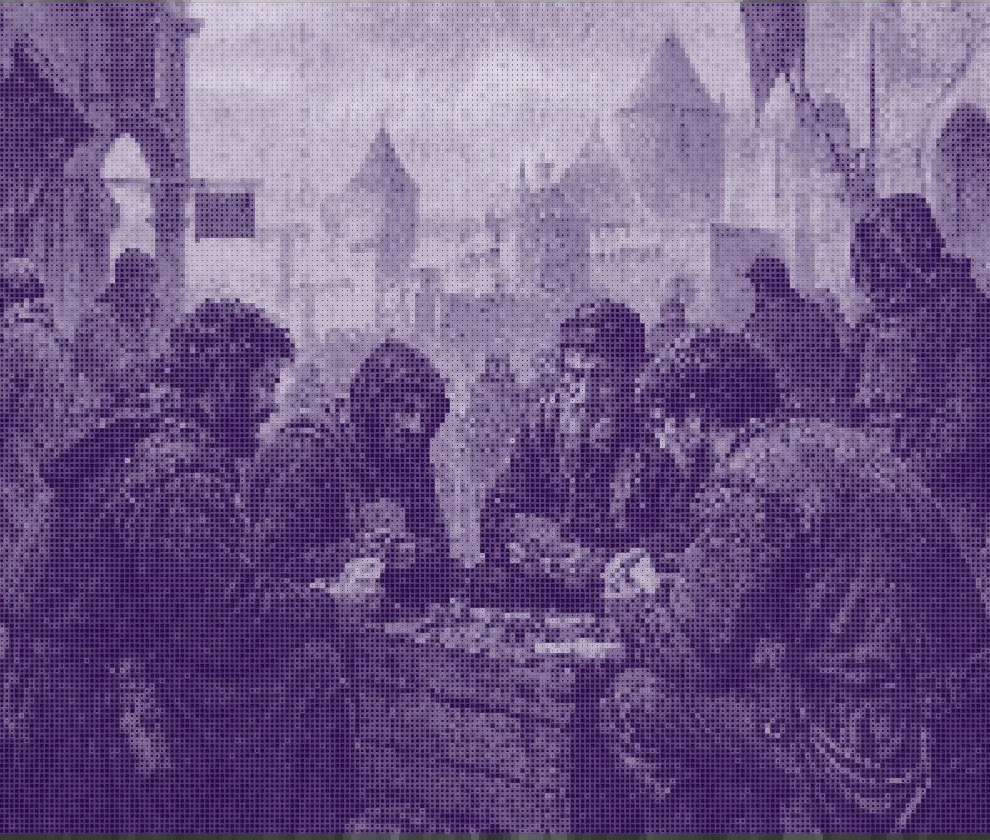
In his ficción “The Lottery in Babylon,” Jorge Luis Borges brings us to face our universe’s probabilistic nature. Borges depicts a society where fate is governed by an omnipotent yet invisible institutionalized Lottery.
“[T]he Lottery is an interpolation of chance into the order of the universe, and observed that to accept errors is to strengthen chance, not contravene it… [T]he number of drawings is infinite. No decision is final; all branch into others.”
— Jorge Luis Borges
The Babylonians attribute every event, from the bird’s morning song to the carpenter’s crooked nail, to the Lottery. This is not dissimilar to how we view the world today. We play this intricate game, navigating drawings we never chose to enter. And, in a world with ever-increasing entropy, it appears the variance of today’s Lottery is at all-time highs.
On a volatile world
Our clients have brought up examples as infinite as the drawings: tariff swings with no resolve, tax credit removals making projects unviable, unwarranted court rulings killing M&As and bankrupting companies. Growing up in regions where volatility is wired into the system, we found these stories painfully familiar. No business should hold a Lottery ticket it never bought.
Stan Druckenmiller claims
“Stock picking is full of macro bets. When an equity guy is playing airlines, he’s making an embedded macro call on oil.”
Yet the logic extends even further: it’s a trade on elections, wars, and policies. A company, today, is an unintentional wrapper of macro events.
These exposures live on corporate balance sheets. Businesses are thus forced to operate in an assumptive state that plans for a single outcome, when the distribution they actually face is multimodal: a different future for each way the drawing can break.
“You’re a kite dancing in a hurricane, Mr. Bond.”
— Raoul Silva, Skyfall
Why? Why must a business dance in hurricanes? Why must it stake its future on the die of another player, at a different table? This volatility should be stripped away.
On the other hand, there are players who actively seek this risk. As quantitative traders, we learned to model the Lottery, assigning a probability to every drawing. And we craved more avenues to express our opinions and to provide liquidity.
Why, then, must a trader express his beliefs through a correlated drawing instead of an explicit one?
Why, above all, does such an egregious disconnect exist? Why can this risk not be transferred, as others so often are?
On our Mission
Castle exists to bridge this gap. We cover the risks that existing insurers won’t, enabling businesses to focus solely on their execution in capturing upside.
Over 3,700 years ago, the Code of Hammurabi offered loan coverage triggered by lost cargo. It then took another 3,000 years until the first standalone insurance contract was recorded in 1347. Parametrics only came into the picture in the late 1990s. Risk transfer has been maturing, albeit slowly, for centuries.
Yet, the vast majority of business risks are intangible, lack historical data, and, therefore, go uninsured. These are precisely the types of risks sophisticated financial actors already trade. This secret has been lying in plain sight, a grave violation of the efficient market hypothesis, and, accordingly, a grave opportunity.
“Everything has been thought of before; the problem is to think of it again.”
— Johann Wolfgang von Goethe
At Castle, we are thinking about risk again, from first principles.
Companies are naturally short (the probability of) certain political events. Castle structures, through event contracts, the offsetting long for them to close and monetize that position. We work with leading quantitative trading desks to source institutional scale liquidity for any hedge. In doing so, we are making prediction markets positive sum.
Castle covers event-based risk. We trim the tails of the Lottery.
On the games we’ve played
“One day I will find the right words, and they will be simple.”
— Jack Kerouac
Simple works. Today, we serve corporations with measurable exposure to a discrete event–a court ruling, a policy change, a price crash in an illiquid commodity. We price a contract that pays on the event, and we source the liquidity to trade it.
Most recently, we paired up with Susquehanna and Kalshi to help Tim Arrowsmith’s Western Grazers, a goat grazing business helping prevent wildfires in California, hedge a policy risk that would have made his costs prohibitively expensive.
Read more on the story in our CNBC exclusive here.
We’ve worked on all sorts of opportunities: tariffs on copper cables, court case outcomes, submarine cable sabotage in the Strait of Hormuz, FIFA World Cup results, carbon credits in Ghana. We even ended up with a (Chinese?) power company at an oil rig in west Texas.
We have already built relationships with the largest traders on prediction markets, and sourcing capacity for our customers is not a constraint. We set up infrastructure to further streamline our quoting workflows, compressing the time from request to print.
On what the future holds
We are all subject to the forces of the Lottery. But the cards can be counted, the variance dampened, and the expectancy maximized. At Castle, we are counting the cards. We are building the models to price and trade risk in new ways.
Castle is the desk corporates go to for offloading unconventional risks. Our main focus for the coming months is to execute more trades.
So, bring us risk. If a business you know is exposed to geopolitical or regulatory uncertainty of any kind, we want to hear about it. Reach us at team@castle.tech
And, as always, please challenge our priors, and reach out anytime with an idea, an intro, or a reason why we’re wrong. We aim to keep the learning curve as steep as possible.
“Truly, for some men nothing is written unless they write it.”
— Sherif Ali, Lawrence of Arabia
We are shifting the distribution of the drawings. We are writing the future of hedging.
All the best,
Lucas, Arjun, Alex, and Bruno
General commentary only. This article is not trading, investment, legal, tax, or insurance advice or a recommendation to enter any transaction. Event contracts are derivatives, not insurance, and involve risk of loss.